Unmuting My Voice™: 90-Day Companion Reader is a
book offered as part of the three-phase
Speak From Power Not Panic™ Masterclass journey,
beginning with Voice Diagnostic Mapping™, followed by the intervention masterclass,
and continuing through the 90-Day Conscious Leadership Integration™ process
supported through monthly one-on-one guided coaching sessions.
Want to experience the book?Flip through the pages on the right.
Want to be part of the next Speak From Power Not Panic™ Masterclass?Click below to reserve your seat.
Would you like to order the companion reader book on its own?Click below.
“I do not raise my voice to be heard. I hold my voice to be whole.”
QNM
Month 1
Defining My Voice, My Speech, and My Fear
Recognising the Landscape of My Voice
Month 1 · Day 2
The Role of Fear in Your Voice
Purpose of Day 2
In Day 1, you explored how fear shows up in your voice. Today, we look at how your voice learned to respond when fear was present.
This day introduces Voice Archetypes, the protective patterns your voice may use to stay safe, accepted, or intact. You are not here to judge your voice. You are here to recognise it.
Fear rarely arrives naked. It often wears the mask of your dominant Voice Archetype or is fuelled by an old Voice Wound. These patterns can make you think the problem is you, when it’s really an old, rehearsed survival script.
Before you go further, take time to understand these fully.
Voice Archetypes
Your voice has a pattern. The way your voice shows up is not random. It’s shaped by what you’ve survived, what you’ve been taught, and the silent agreements you’ve made just to stay safe.
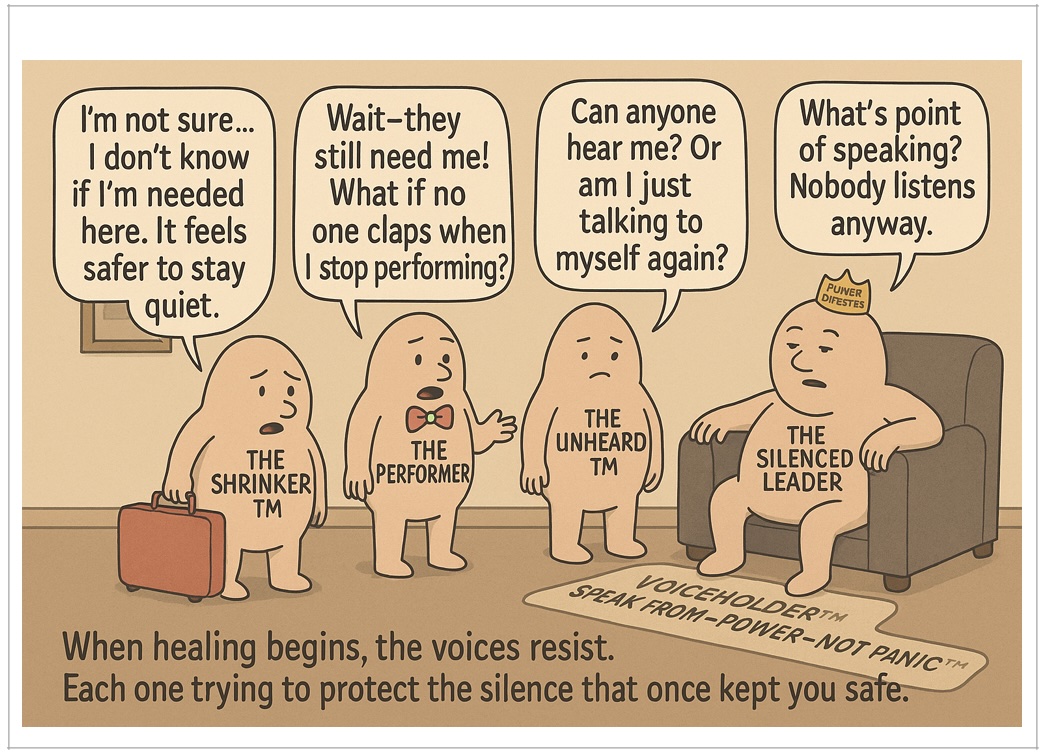
In Speak From Power — Not Panic™, we identify five distinct Voice Archetypes that describe common, yet often invisible, voice patterns. These are not personality types. They are survival postures. They reflect the way we learned to protect our truth in environments that didn’t always welcome it.
You may see yourself in one. You may see pieces of yourself in many. What matters is that you begin to recognise the voice you use most, and reflect on why.
A deeper understanding of each archetype will help you identify the patterns you’ve been rehearsing, often without realising it.
Voice Archetype™ Mirror
When your voice is protecting you — these questions hold a mirror to the patterns that have muted you.
1 · The Shrinker
“I have something to say… but I shrink to stay safe.”
When did you last have something to say but swallow it instead?
Who taught you that shrinking keeps you safe? Are they still in control?
What apology do you offer before you even speak?
Where in your body do you disappear when it’s time to take up space?
Finish this: If I took up my full voice, I’m afraid they would…
2 · The Unheard
“I keep speaking… but the room never listens.”
When do you feel the urge to repeat yourself, and what is the fear beneath it?
What parts of your voice feel loud, but still not heard?
Who do you feel invisible around, even when you’re giving your all?
What does being heard actually mean to you?
Can you recall the first time you felt silenced? What did you do with that pain?
Mirror (continued)
3 · The Performer
“I sound confident… but I don’t feel seen when I’m real.”
What parts of you are always ‘on’? What parts never get to breathe?
Where are you clapping for yourself, and where are you still waiting for applause?
What do you polish in your speech or image to feel accepted?
When you remove the mask, even privately, who are you?
What would it mean to be powerful and messy in the same breath?
4 · The Silenced Leader
“I used to lead with my voice… until it cost me too much.”
What did you lose when you last spoke up, and what part of you never came back?
How have you learned to protect yourself by withholding your brilliance?
Who disappointed you most when you needed support?
What would leadership sound like from your healed voice?
Are you still punishing your future for a past betrayal?
Mirror (continued)
5 · The Voiceholder™
“I do not raise my voice to be heard. I hold my voice to be whole.”
What does congruence feel like in your voice?
Where do you pause, not out of fear, but out of power?
What are you no longer willing to explain?
How do you discern when to speak and when to stay silent?
What does wholeness sound like in your leadership?
You may recognise more than one archetype. This is normal. Voices adapt.
Mirror: Self-Check
Tick what feels familiar right now. No right or wrong answers — just notice your patterns with care.
The Shrinker
☐I apologise before I speak — “Sorry, but…”
☐I soften my truth to keep the peace.
☐I worry my thoughts are “not smart enough” or “too much.”
☐I’ve stayed quiet in meetings with something valuable to say.
☐I make myself less visible in groups.
The Unheard
☐I over-explain because I don’t feel truly understood.
☐People hear me but don’t listen to me.
☐I repeat myself or talk fast, hoping something lands.
☐I feel invisible, even when I’m putting in effort.
☐I over-share when I’m feeling insecure.
The Performer
☐I know how to say what people want to hear.
☐I present well, but inside feel disconnected or exhausted.
☐I struggle to be vulnerable without rehearsing.
☐I fear that if I stop performing, I’ll lose approval.
☐I’m praised, but don’t feel seen in my truth.
Self-Check (continued)
The Silenced Leader
☐I used to speak boldly, but it cost me.
☐I’ve been punished or betrayed for using my voice.
☐I now second-guess myself before I speak.
☐I often stay silent to protect myself.
☐I lead quietly, but miss being expressive.
The Voiceholder™
☐I choose when to speak and when to stay silent, with clarity.
☐I don’t need to be loud to be powerful.
☐I speak from my centre, not from fear.
☐I stay whole, even when misunderstood.
☐I use my voice for alignment, not approval.
Tick 3 or more in any group and that pattern may be showing up for you right now.
Voice Archetype™ Mirror: Reflection
Please take a moment to reflect on the following:
The voice that shows up most often is: ____________________________
This voice protects me by: ____________________________
But this voice costs me: ____________________________
I am learning to make space for more of: ____________________________
You may recognise more than one voice. Each learned a way to keep you intact. Notice which one speaks the loudest.
When healing begins, the voices resist — each one trying to protect the silence that once kept you safe.
On Day 3, we trace where it learned its role.
Month 1 · Day 3
Understanding Your Wounds
Purpose of Day 3
Now that you’ve met the echo… let’s trace the origin. Your archetype is how your voice behaves. Let’s learn about the injury which trained your archetype to behave that way.
The wound.
Voice Wounds
Before unmuting the voice, we must name what silenced it. Not all silence is chosen. Some is trained. Some is inherited. And some is enforced through trauma, socialisation, betrayal, or unspoken rules that reward performance and punish truth.
Voice Wounds (continued)
In Speak From Power — Not Panic™, we work with what we call Voice Wounds. These are emotional injuries that shape not only how you speak, but whether you believe you even have the right to speak at all.
Some formed early — in childhood, classrooms, places of worship, or family structures. Others were shaped by systems, money, patriarchy, gendered expectations, and institutional dynamics that slowly taught your voice to behave, to bend, or to break.
Every Voice Wound has its own language, its own echo in your nervous system, and its own way of rewriting your identity around survival. We group them into two categories:
Core Wounds · Specialised & Hidden Wounds™
Category One: Core Wounds
The first fractures — early injuries formed before you had language for them. Five foundational wounds identified by Lise Bourbeau.
Rejection Wound tells you your presence is too much, unwelcome, or not worth choosing. You begin to silence yourself before others can. You stop raising your hand. You stay small, just in case.
Abandonment Wound tells you you’re not worth staying for. So you work harder. You love harder. You explain more. You speak not from presence, but from the fear of disappearing.
Core Wounds (continued)
Humiliation Wound says: if they see you unpolished, they will use it against you. So you get good. You get excellent. You get perfect. But your voice starts to sound like performance instead of truth.
Betrayal Wound is being punished for telling the truth — stabbed with what you said in confidence. So now you speak carefully, if at all, protecting your wisdom like it’s dangerous to be wise.
Injustice Wound is being overlooked even when you’ve done everything right. You give twice the effort for half the recognition. Your voice becomes a tool for proving instead of expressing. Until named, these fractures repeat.
Category Two: Hidden Wounds™
Specialised & Hidden Wounds™ — the cultural contracts that keep us mute.
These wounds are formed through lived experience within systems of power, gender, money, culture, and unspoken social expectations. They influence how the voice learns to protect itself through over-giving, self-silencing, performance, or emotional compliance.
They are passed down quietly, learned through systems and silences that reward self-erasure. They don’t always present as trauma, but they bend your voice all the same — in how you defer, the forgiveness offered before the apology, the money given when you can’t afford to.
And yes — you can be carrying more than one of these.
The Giver Wound™
This wound wraps itself in generosity. It tells you that your goodness is proven through sacrifice, not presence — that if you stop giving, you will lose connection. That to say, “I have nothing left to offer,” is to become unworthy.
So you keep giving. Time. Energy. Money. Labour. Ideas. Applause. You overextend. And when no one sees what it’s costing you, the wound grows quiet, but deeper.
Your voice begins to believe that its primary job is to serve, not to exist.
Hidden Wounds™ (continued)
The Men Wound™ was formed where maleness was centred and you were told, directly or silently, that your brilliance shouldn’t disturb it. You make space, you adjust, you over-function. Your voice calculates how much truth it can afford to speak. The cost is loud, even when the room is silent.
The Emotional Financial Knot™ (EFK) is not about money alone. Love, obligation, survival, and guilt become entangled. You give when you don’t have it, because saying “no” feels like betrayal. You confuse being needed with being loved — and pay with your nervous system, your peace, and your voice.
The Approval from the Perpetrator Wound™
You were hurt. Maybe humiliated. Maybe dismissed. Maybe betrayed. But what keeps the wound open is that the person who harmed you refuses to name it.
So you stay in the waiting room. You replay the story. You over-explain the impact. You repackage the truth to make it palatable, hoping they’ll say, “You were right. It wasn’t okay.” And your healing becomes tied to their confession.
But they don’t confess. Your voice begins to orbit their silence — until one day it stops. Not from peace, but from exhaustion.
The Voiceholder™ & the Evolution of Healing
The Voiceholder™ is not a healed voice. It is a discerning one. It recognises wounds without being governed by them. It pauses from clarity, not fear. It does not seek permission for validity — it knows it already has it.
Healing here is not a destination. It is a posture. A daily orientation toward wholeness. A rooted refusal to become silent again.
Fear did not appear from nowhere. It learned its role. The patterns you identified were shaped by experiences and injuries that taught your voice how to stay safe.
Tomorrow, we begin tracing how those wounds became habits — and how those habits became the voice patterns you live from today.
QNM LEADERSHIP INSTITUTE
Unmuting My Voice™
90-Day Companion Reader A Conscious Leadership Integration™ Journey
www.QNMLeadership.africa
Page 1 of —
Preview only. Full content available in the printed book.
QNMLeadership Institute
Book a Masterclass
Speak From Power Not Panic™ Masterclass — Reserve Your Seat
Enquiry Received!
A confirmation email has been sent to your inbox.
Automated Response — Sent to Your Inbox
From: QNMLeadership Institute <qnm@qnmleadership.africa> To:you Subject: Your Speak From Power Not Panic™ Masterclass Enquiry
Dear there,
Thank you for expressing interest in the Speak From Power Not Panic™ Masterclass.
We have received your enquiry and one of our team members will be in touch shortly with information on upcoming masterclass dates, investment details, and registration.
If you have any urgent questions please reach us at: qnm@qnmleadership.africa
Warm regards, QNM Leadership Institute
Order the Companion Reader
QNMLeadership Institute
Unmuting My Voice™: 90-Day Companion Reader
Order Request Received
A confirmation email has been sent to your inbox.
Automated Response Email — Sent to Your Inbox
From: QNMLeadership Institute <qnm@qnmleadership.africa> To:you Subject: Your Unmuting My Voice™ Companion Reader Book Order Request
Dear there,
Thank you for your investment interest in Unmuting My Voice™: 90-Day Companion Reader.
Please proceed with payment using the banking details below:
Banking Details
BankABSA
Account NameQNMLeadership Institute
Account Number9398 9161 10
ReferenceYour Name + UMV
Please forward proof of payment to: qnm@qnmleadership.africa
Once payment is confirmed, your order will be processed and prepared for dispatch.